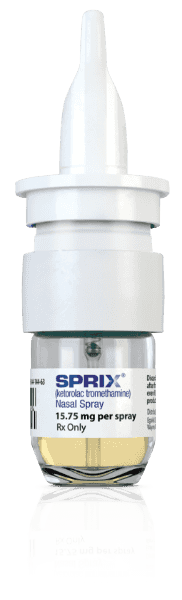
WARNING: RISK OF SERIOUS CARDIOVASCULAR AND GASTROINTESTINAL EVENTS
Cardiovascular Thrombotic Events
-
Nonsteroidal anti-inflammatory drugs (NSAIDS) cause an increased risk of serious cardiovascular thrombotic events, including myocardial infarction and stroke, which can be fatal. This risk may occur early in treatment and may increase with duration of use.
-
SPRIX ® is contraindicated in the setting of coronary artery bypass graft (CABG) surgery.
Gastrointestinal Bleeding, Ulceration, and Perforation
-
NSAIDS cause an increased risk of serious gastrointestinal (GI) adverse events including bleeding, ulceration, and perforation of the stomach or intestines, which can be fatal. These events can occur at any time during use and without warning symptoms. Elderly patients and patients with a prior history of peptic ulcer disease and/or GI bleeding are at greater risk for serious GI events.
Use the lowest effective dosage for shortest duration consistent with individual treatment goals.
Indications and Usage
SPRIX ® (ketorolac tromethamine) is indicated in adult patients for the short term (up to 5 days) management of moderate to moderately severe pain that requires analgesia at the opioid level.
Limitations of Use
- Sprix is not for use in pediatric patients less than 2 years of age.
IMPORTANT SAFETY INFORMATION (continued)
Contraindications
SPRIX is contraindicated in the following patients:
-
Known hypersensitivity to ketorolac or any components of the drug product.
-
History of asthma, urticaria, or other allergic-type reactions after taking aspirin or other NSAIDs. Severe, sometimes fatal, anaphylactic reactions
to NSAIDs have been reported in such patients.
-
In the setting of coronary artery bypass graft (CABG) surgery.
-
Use in patients with active peptic ulcer disease or with recent gastrointestinal bleeding or perforation.
-
Use as a prophylactic analgesic before any major surgery.
-
Use in patients with advanced renal disease or patients at risk for renal failure due to volume depletion.
-
Use in labor and delivery. May adversely affect fetal circulation and inhibit uterine contractions, thus increasing the risk of uterine hemorrhage.
-
Use in patients with suspected or confirmed cerebrovascular bleeding, hemorrhagic diathesis, incomplete hemostasis, or those for whom hemostasis is critical.
-
Concomitant use with probenecid or pentoxifylline.
Warnings and Precautions
Post-Coronary Artery Bypass Graft (CABG) Surgery: Clinical trials of a COX-2 selective NSAID used to treat pain in the first 10-14 days following CABG surgery found an increased incidence of MI and stroke. NSAIDs are contraindicated in the setting of CABG.
Post-MI Patients: Avoid the use of SPRIX in patients with a recent MI unless the benefits are expected to outweigh the risk of recurrent CV thrombotic events. If SPRIX is used in patients with a recent MI, monitor patients for signs of cardiac ischemia.
Gastrointestinal Bleeding, Ulceration, and Perforation: SPRIX is contraindicated in patients with active peptic ulcers and/or GI bleeding, and in patients with recent GI bleeding or perforation. NSAIDs, including SPRIX, cause serious GI adverse events including inflammation, bleeding, ulceration, and perforation of the esophagus, stomach, small intestine, or large intestine, which can be fatal. These serious adverse events can occur at any time, with or without warning symptoms.
Hepatotoxicity: Elevations of ALT or AST have been reported in patients with NSAIDs. In addition, rare, sometimes fatal, cases of severe hepatic injury, including fulminant hepatitis, liver necrosis, and hepatic failure have been reported. Inform patients of warning signs and symptoms of hepatotoxicity. Discontinue immediately if abnormal liver tests persist or worsen or if clinical signs and symptoms of liver disease develop.
Hypertension: NSAIDs, including SPRIX, can lead to new onset or worsening of preexisting hypertension either of which may contribute to the increased incidence of CV events. Patients taking some antihypertensive medications may have impaired response to these therapies when taking NSAIDs. Monitor blood pressure.
Heart Failure and Edema: Avoid use of SPRIX in patients with severe heart failure unless benefits are expected to outweigh risk of worsening heart failure. If SPRIX is used in patients with severe heart failure, monitor patients for signs of worsening heart failure.
Renal Toxicity and Hyperkalemia: Long-term administration of NSAIDs has resulted in renal papillary necrosis and other renal injury and may cause a dose-dependent reduction in prostaglandin formation, which may precipitate overt renal decompensation. Monitor renal function in patients with renal or hepatic impairment, heart failure, dehydration, or hypovolemia. Avoid use of SPRIX in patients with advanced renal disease unless benefits are expected to outweigh risk of worsening renal function.
Anaphylactic Reactions: Seek emergency help if an anaphylactic reaction occurs.
Exacerbation of Asthma Related to Aspirin Sensitivity: SPRIX is contraindicated in patients with aspirin-sensitive asthma. Monitor patients with preexisting asthma (without known aspirin sensitivity).
Serious Skin Reactions: NSAIDS, including ketorolac, can cause serious skin reactions such as exfoliative dermatitis, Stevens-Johnson Syndrome (SJS), and toxic epidermal necrolysis (TEN), which can be fatal. NSAIDs can cause fixed drug eruption (FDE), including generalized bullous fixed drug eruption (GBFDE), which can be life-threatening. These serious events may occur without warning. Discontinue SPRIX at first appearance of skin rash or other signs of hypersensitivity. SPRIX is contraindicated in patients with previous serious skin reactions to NSAIDs.
Fetal Toxicity: Limit use of NSAIDs, including SPRIX, between about 20 to 30 weeks in pregnancy due to the risk of oligohydramnios/fetal renal dysfunction. Avoid use of NSAIDs in women at about 30 weeks gestation and later in pregnancy due to risks of oligohydramnios/fetal renal dysfunction and premature closure of the fetal ductus arteriosus.
Drug Rash with Eosinophilia and Systemic Symptoms (DRESS): Cases of DRESS, some fatal or life-threatening, have been reported in patients taking NSAIDs, such as SPRIX. Typical presentation of DRESS includes fever, rash, lymphadenopathy, and/or facial swelling. Other manifestations may include hepatitis, nephritis, hematological abnormalities, myocarditis, or myositis. DRESS may resemble an acute viral infection. Eosinophilia is often present. If any signs or symptoms of DRESS occur, discontinue SPRIX and evaluate the patient immediately.
Hematologic Toxicity: Anemia has occurred in patients treated with NSAIDS. Monitor hemoglobin or hematocrit in patients with any signs or symptoms of anemia. Do not use SPRIX in patients for whom hemostasis is critical.
Masking of Inflammation and Fever: The pharmacological activity of SPRIX in reducing inflammation, and possibly fever, may diminish the utility of diagnostic signs in detecting infections.
Laboratory Monitoring: Because serious GI bleeding, hepatoxicity, and renal injury can occur without warning symptoms or signs, consider monitoring patients on long-term NSAID treatment with a CBC and a chemistry profile periodically.
Eye Exposure: Avoid contact of SPRIX with the eyes. If eye contact occurs, wash out the eye with water or saline, and consult a physician if irritation persists for more than an hour.
Limitations of Use: The total duration of use of SPRIX alone or sequentially with other forms of ketorolac is not to exceed 5 days. SPRIX should not be used concomitantly with other forms of ketorolac, or other NSAIDs.
Drug Interactions
Drugs that interfere with hemostasis: increased risk of serious bleeding with use of anticoagulants, antiplatelet agents, selective serotonin reuptake inhibitors (SSRIs), and serotonin norepinephrine reuptake inhibitors (SNRIs); concomitant use with pentoxifylline is contraindicated.
ACE inhibitors, angiotensin receptor blockers (ARBs), and beta-blockers: may diminish the antihypertensive effect of these drugs; monitor blood pressure.
ACE Inhibitors and ARBs: In elderly, volume depleted, or those with renal impairment may result in deterioration of renal function; monitor for signs of worsening renal function.
Diuretics: reduces the natriuretic effect of loop diuretics (e.g., furosemide) and thiazide diuretics in some patients. During concomitant use of SPRIX with diuretics look for signs of worsening renal function and assure diuretic efficacy and antihypertensive effects.
Digoxin: has been reported to increase the serum concentration and prolong the half-life of digoxin, monitor serum digoxin levels.
Adverse Reactions
The most common adverse reactions (incidence ≥2%) in patients treated with SPRIX and occurring at a rate at least twice that with placebo include: nasal discomfort; rhinalgia; increased lacrimation; throat irritation; oliguria; rash; bradycardia; decreased urine output; increased ALT and/or AST; hypertension; rhinitis.
Use in Specific Populations
Pregnancy: Use of NSAIDs, including SPRIX, can cause premature closure of the fetal ductus arteriosus and fetal renal dysfunction leading to oligohydramnios and, in some cases, neonatal renal impairment. Because of these risks, limit dose and duration of SPRIX use between about 20 and 30 weeks of gestation, and avoid SPRIX use at about 30 weeks of gestation and later in pregnancy.
Infertility: NSAIDs are associated with reversible infertility. Consider withdrawal of SPRIX in women who have difficulties conceiving.
Please see Full Prescribing Information, including BOXED WARNING and MEDICATION GUIDE.
To report SUSPECTED ADVERSE REACTIONS, contact Cosette Pharmaceuticals, Inc at 1-800-922-1038 or FDA at 1-800-FDA-1088 or
ww.fda.gov/medwatch.